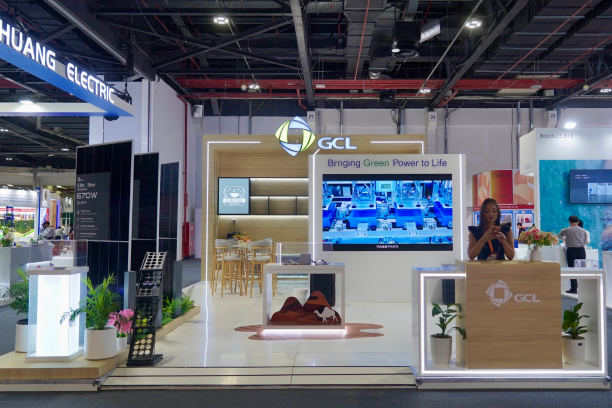



At SNEC 2026 in Shanghai, GCL System Integration (GCL SI) presented a broader view of its next-generation module strategy, with GPC 3.0 back-contact modules, scenario-based product design and the EcoPower Mate mobile PV-storage system among the key themes. In a one-on-one interview, Huang Gengwen, Executive Dean of GCL SI’s Module Research Division, discussed how the company is approaching efficiency, reliability, differentiated applications, off-grid energy systems and overseas compliance.
.png)
For that type of product, we target around 500W for this product. We also use colorless glass so that multiple modules installed together have a more consistent visual effect, without color deviation between modules.
This is very important for residential rooftops and commercial buildings, especially in Europe and other markets where visual integration is part of the purchasing decision.
Q3: When you design these differentiated GPC 3.0 products, how do you balance aesthetics, efficiency and long-term reliability?
Huang Gengwen:
For us, reliability is always the foundation.
A module may look good and have high power, but if it cannot perform reliably for 25 or 30 years, then it is not a good product. Therefore, reliability is our primary consideration in all design decisions.
For example, in some critical current-collection areas, such as ribbons and busbars, we still use high-temperature soldering, since these areas carry current and operate under long-term thermal stress. Using low-temperature processes in unsuitable areas could increase the risk of degradation or detachment over time.
So, we do not apply a uniform process. Instead, we match processes to specific positions: some areas use low-temperature encapsulation, while others still require high-temperature processes.
Product details matter. Reliability often comes from these details.
Q4: GCL SI also presented EcoPower Mate at SNEC. From a system perspective, how should we understand this product? Is it only a mobile solar product, or is it part of a broader energy solution?
Huang Gengwen:
EcoPower Mate is part of a complete energy system, not a standalone product.
It is a containerized, mobile PV-storage solution designed for rapid deployment and flexible integration with other energy resources.
.png)
For that type of product, we target around 500W for this product. We also use colorless glass so that multiple modules installed together have a more consistent visual effect, without color deviation between modules.
This is very important for residential rooftops and commercial buildings, especially in Europe and other markets where visual integration is part of the purchasing decision.
Q3: When you design these differentiated GPC 3.0 products, how do you balance aesthetics, efficiency and long-term reliability?
Huang Gengwen:
For us, reliability is always the foundation.
A module may look good and have high power, but if it cannot perform reliably for 25 or 30 years, then it is not a good product. Therefore, reliability is our primary consideration in all design decisions.
For example, in some critical current-collection areas, such as ribbons and busbars, we still use high-temperature soldering, since these areas carry current and operate under long-term thermal stress. Using low-temperature processes in unsuitable areas could increase the risk of degradation or detachment over time.
So, we do not apply a uniform process. Instead, we match processes to specific positions: some areas use low-temperature encapsulation, while others still require high-temperature processes.
Product details matter. Reliability often comes from these details.
Q4: GCL SI also presented EcoPower Mate at SNEC. From a system perspective, how should we understand this product? Is it only a mobile solar product, or is it part of a broader energy solution?
Huang Gengwen:
EcoPower Mate is part of a complete energy system, not a standalone product.
It is a containerized, mobile PV-storage solution designed for rapid deployment and flexible integration with other energy resources.
.png)
In scenarios such as AI data centers and high-performance computing loads, power demand fluctuates rapidly. EcoPower Mate works together with energy storage systems, diesel backup, and EMS energy management to ensure stable and high-quality power supply.
It is the PV generation front-end within a broader integrated energy architecture.
Q5: How do EcoPower Mate, energy storage, diesel backup and EMS work together in such a system?
Huang Gengwen:
EcoPower Mate is designed to be quickly deployed and automatically operated. It uses servo motors for automatic deployment, which is important in overseas markets where labor conditions or costs may be limited.
From landing on site to full deployment, the system can complete the process in about two to three hours. This reduces the difficulty of project execution.
EMS acts as the brain of the system, controlling generation and energy usage. PV output varies with sunlight, and the best generation window is limited. EMS helps optimize PV usage and prioritize green power.
Storage plays the buffering role. It stores surplus energy when load is low and releases it when demand increases. With power electronics, we can improve coordination between PV and storage.
Diesel generation is mainly a backup source. It is not environmentally friendly and has high fuel cost, so the preferred approach is to maximize coordination between EcoPower Mate and storage, with EMS managing overall dispatch.
Q6: What business models do GCL SI plan to use for EcoPower Mate? Will it be sold as a complete system, or can customers choose more flexible cooperation models?
Huang Gengwen:
We are very flexible and have three models.
The first is solution design. We design the system, while customers may choose other partners for implementation, especially in cases with localization or compliance requirements. For example, some parts such as PCS may involve local data security, energy security or compliance rules. Certain components may need to be produced locally.
The second is full-system delivery, where we provide the complete solution.
The third is cooperation through local agents or distributors. However, EcoPower Mate is mainly a B2B system, so this is not the primary model.
Our principle is flexibility. We do not insist on a fixed package, but instead design based on customer needs.
Q7: Reliability is now one of the industry’s most important concerns. How does GCL SI turn reliability from a corporate promise into something verifiable for customers and financiers?
Huang Gengwen:
Basic certification is something everyone does. For us, reliability has two main layers.
First is cooperation with third-party institutions such as TÜV and TÜV Rheinland for more stringent testing. We do not only test at the basic standard level. In many cases, we do double or even triple-level validation.
For example, we conduct extended damp heat, thermal cycling, humidity-freeze, salt mist, sand dust, ammonia and other tests. We also test areas that the industry is paying close attention to, such as PID, LeTID and UVID.
The second layer is field validation. We deploy products in different regions and climates worldwide, including high temperature, high humidity, extreme cold and dry heat environments, and track performance and degradation over time.
We then use real-world data to demonstrate whether performance meets expectations. Data is more convincing than statements.
Q8: European customers increasingly require local compliance, carbon-footprint documentation and supply-chain transparency. How is GCL SI responding to these requirements?
Huang Gengwen:
GCL is a vertically integrated company covering the full value chain from materials to modules and system solutions, and now we are also moving into broader system solutions such as those related to AIDC.
For overseas compliance, we work with third-party institutions for certification and carbon-footprint verification and also work closely with customers to co-develop solutions.
We need to understand customer requirements and combine strengths from both sides to develop the final solution.
In practice, full localization is difficult due to regulatory and supply-chain constraints in different regions. A more realistic approach is a hybrid model, combining localized cooperation with centralized supply, supported by third-party verification and supply-chain coordination.
Ultimately, value and reliability are the core priorities for customers.


.png)